
In short: Between 1990 and 1993 the beach at Harrison Hot Springs, British Columbia, saw three successive world records for the tallest hand-built sandcastle: 17 feet 6 inches, 19 feet 5 inches and 21 feet 6 inches (6.3 m). The rules banned machinery and capped the work at 100 person-hours. Today’s Guinness record, built with machinery, is 21.16 m, set in Denmark in 2021.
This page tells the story of the Harrison records, based on the archive text of the contest’s old website, and compares them with the modern record. This site is independent and is not run by the contest’s organisers.
How the record category began
During the 1989 Harrison Open Sandcastle Contest, most team entries built central pieces between ten and twelve feet tall. The highlight was “Feeding Time” by Freddie & The Sandblasters of Victoria, BC. An engineer measured it at 15 feet 6 inches, and its base was less than half its height.
John Green, vice-president of the Harrison Hot Springs Sand Sculpture Society, wrote to the Guinness Book of Records to ask whether it was a new kind of record. Guinness did not accept Feeding Time itself, but it did create a new category along the lines of the Harrison contest.
The rules
Under the new category, a sandcastle had to:
- be built only of sand and water;
- be built without mechanical equipment;
- be built within a limit of 100 person-hours;
- have a base no wider than its height;
- be measured by an engineer or surveyor;
- be certified by an independent source and confirmed by local media.
The base rule mattered most. It stopped teams from simply piling up a wide mound of sand and forced them to build a true tower, which tests both the sand and the sculptors’ skill.
Three records in four years
| Date | Sculpture and team | Height |
|---|---|---|
| April 1990 | Pacific Northwest Sandshapers, a coalition of master sculptors from Washington State and British Columbia | 17 ft 6 in |
| October 1991 | “Halloween”, led by Freddie Dobbs of Victoria, BC and Ted Siebert of Seattle | 19 ft 5 in |
| September 1993 | “The Christmas Tree”, by Joe Maize, Ted Siebert and George Pennock, assisted by Rob Cross and Robbie Yates | 21 ft 6 in (6.3 m) |
The first Sandshapers attempt collapsed: the top was too heavy to be supported once the lower forms were removed. The team rebuilt and finished at 17 feet 6 inches. “Halloween” was built in front of the Harrison Hot Springs Hotel and stood for more than two weeks. “The Christmas Tree” went up during the 1993 exhibition in only 86 person-hours, well inside the limit.
How the record grew after Harrison
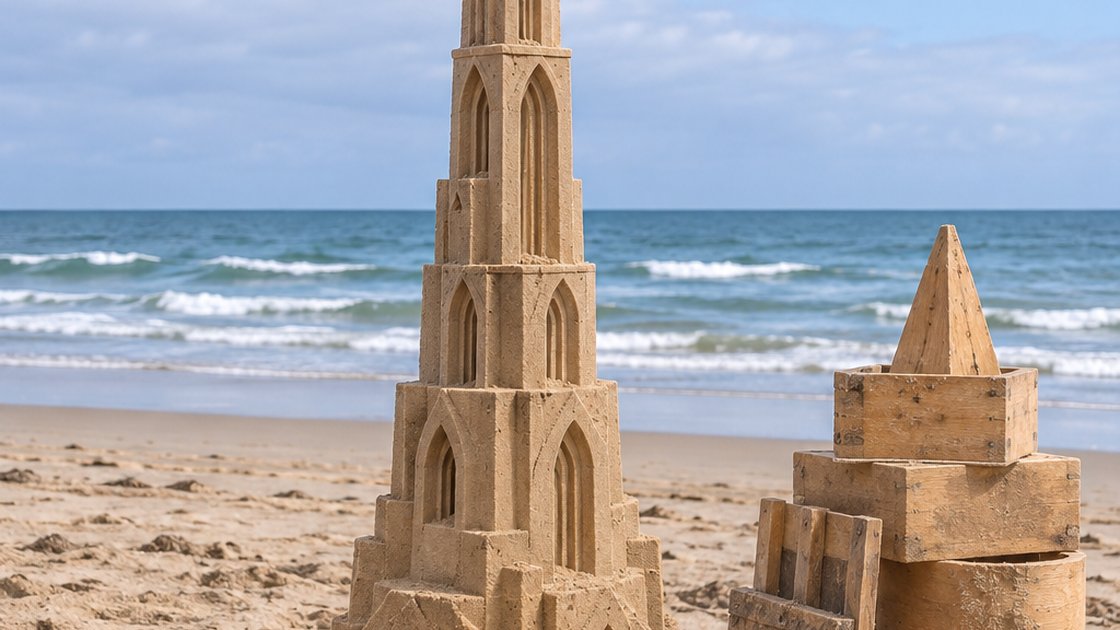
Later records were set under different rules, with machinery, large teams and far more sand. The previous record before the current one was 17.66 metres, built in Binz, Germany, in 2019 (RTÉ). On 2 July 2021 Skulpturparken Blokhus in Denmark completed a sandcastle 21.16 metres (69 feet 5 inches) tall, which Guinness World Records lists as the tallest sandcastle. Its base measures more than 30 metres (Guinness World Records). It was built by about 30 sculptors under the Dutch artist Wilfred Stijger, using some 4,860 tonnes of sand mixed with about 10% clay, inside a wooden structure (WZZM, citing Reuters, Physics World).
The Blokhus castle is about three times taller than “The Christmas Tree”, but the two records are not directly comparable. The Harrison towers were built by a handful of sculptors with hand tools, plywood forms and a strict time limit; the Danish castle was an engineering project.
Why Harrison’s sand could do it
The sand at Harrison was dredged from the bottom of Harrison Lake. Its grains are angular and very silty, so they lock together when compacted with water. Ocean sand is usually rounder after centuries of rolling in the surf and does not stack as well. See how sand sculpture works for more.
Common questions
What is the tallest sandcastle ever built?
According to Guinness World Records, it is a 21.16-metre sandcastle built by Skulpturparken Blokhus in Blokhus, Denmark, on 2 July 2021.
How tall was the Harrison record?
The highest Harrison record was “The Christmas Tree” in September 1993, at 21 feet 6 inches, or 6.3 metres.
Can a sandcastle be made only of sand and water?
Yes. The Harrison records used only sand and water. Modern giant sculptures sometimes add clay to the sand and spray a glue layer on the surface so they last longer.
Sources
- Guinness World Records: Tallest sandcastle
- RTÉ: World’s tallest sandcastle unveiled in Denmark
- Physics World: the weird world of sand
- WZZM: World’s tallest sandcastle built in Denmark
- Archive text of the Harrison Hot Springs contest’s former website.