
What this site is: an independent history of sand sculpture at Harrison Hot Springs, British Columbia, and a guide to how sand sculpture works. It is not the Harrison Hot Springs Sand Sculpture Society, and it is not run by any contest organiser. It does not sell tickets or run events. Last updated 19 November 2026.
For two decades, the small lakeside village of Harrison Hot Springs, in the Fraser Valley east of Vancouver, hosted one of the world’s best-known sand sculpture contests. The World Championships of Sand Sculpture were held there from 1989 to 2009 (Wikipedia). The contest drew master sculptors from around the world, and its beach saw three successive Guinness World Records for the tallest sandcastle. This site tells that story and explains how such sculptures are built.
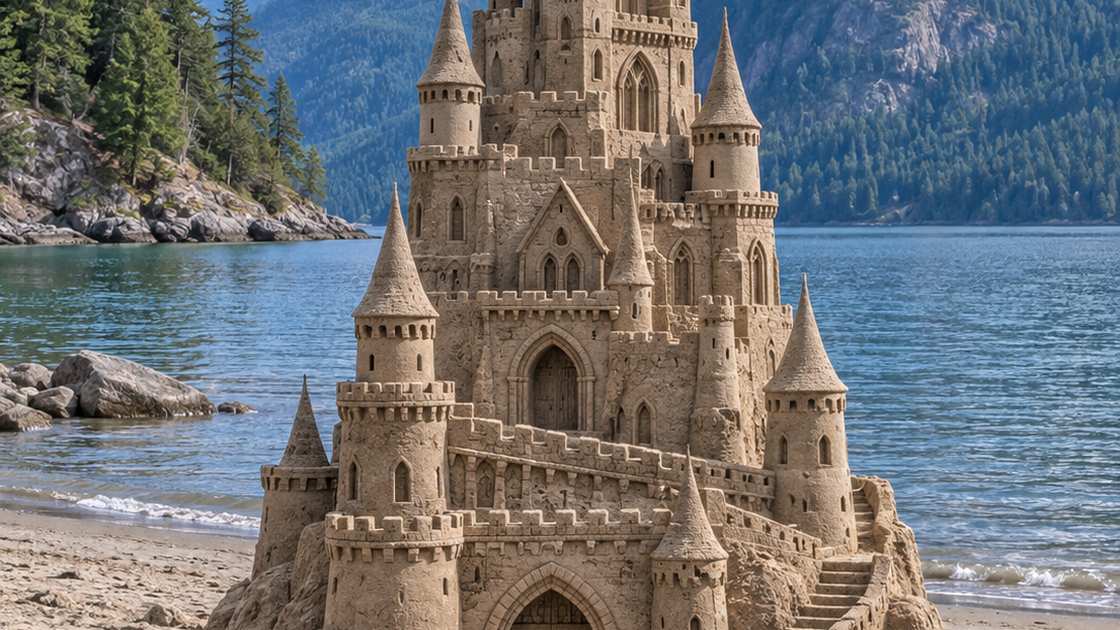
Sand sculpture festivals now run on beaches around the world. Pattaya held its first sand art festival, the Pattaya Sand & Art Festival, on Pattaya Beach in front of Central Pattaya from 27 to 31 August 2026, with five large sand sculptures (Bangkok Post). SiamFest lists Thailand’s festival dates for 2026-2027, with trip plans for each.
Start here
- The tallest sandcastle records: how Harrison’s beach set three Guinness records between 1990 and 1993, and how the record has grown since.
- How do they do that? Why sand holds together, why Harrison’s sand was special, and how sculptors build with forms.
- The 2008 Tournament of Champions: one of the contest’s last editions.
- The 2006 competition and exhibition: the schedule from the contest’s later years.
A short history
The contest grew out of the Harrison Open Sandcastle Contest. By 1989 team entries were building central pieces ten to twelve feet tall, and one, “Feeding Time” by Freddie & The Sandblasters of Victoria, BC, was measured at 15 feet 6 inches. A request to Guinness about that sculpture led to a new record category for hand-built sandcastles, written along the lines of the Harrison rules.
The event became a fixture of the late summer. The Globe and Mail described it as starting the Tuesday after Labour Day, with the finished sculptures left standing on the beach until October (The Globe and Mail). In 2004 Karen Fralich of Guelph, Ontario became the first woman to win the world title there (GuelphToday, The Tico Times).
Why Harrison worked
Most ocean beach sand has been rolled by the surf for centuries and its grains are round, which makes it hard to stack. The sand at Harrison was dredged from the bottom of Harrison Lake. It was angular and very silty, so when packed with water it held together well enough for sculptors to build pieces more than twelve feet tall in competition. Our technique guide explains why.
Records then and now
The Harrison record reached 21 feet 6 inches (6.3 metres) with “The Christmas Tree” in September 1993. Since then the record for the tallest sandcastle has been pushed far higher with larger teams, heavy machinery and huge volumes of sand. The current Guinness record is 21.16 metres, set in Blokhus, Denmark, on 2 July 2021 (Guinness World Records).
About this site
This web address once belonged to the Harrison contest. The current site is an independent history based on published sources and on the archive text of the old site, and its pictures are illustrations rather than photographs of real sculptures. Read more on the about page.